
Invisible Ingredients, Visible Upside: Croda Is Good Chemistry Going Cheap(ish)
This classy compounder is in the bargain bin right now, but it won’t be for long.

I’ve got history with this one. Back in my Goldman Sachs days, Croda was the name everyone wanted on their books – the consistently growing chemicals business that did unglamorous, utterly essential chemistry beautifully. You’ve probably used its stuff without ever knowing it: it makes the invisible ingredients that help your shampoo lather, your moisturizer sink in, your crops grow, and your vaccines work. Bankers were forever tipping this classy compounder as the next big takeover target.
For a while, though, it was simply too expensive to touch – especially during the Covid years, when its products were key to life-saving vaccine delivery. But when shares plunged 70% from that pandemic-era peak, pushed down by a combination of factors, the market more or less stopped paying attention.
And that’s exactly why I’m interested now. The reasons it got cheap are slowly fading, the business is turning a corner, and, let’s be honest, a top-quality name like this isn’t going to sit in the bargain bin for long.
Part 1: What does Croda do?
Croda isn’t a household name, but there’s a decent chance you’ve used something that depends on its products. The UK specialty chemicals firm makes the high-performance ingredients in hundreds of everyday products, such as skincare creams, shampoos, laundry detergents, fragrances, vaccines, crop sprays, lubricants, and coatings.
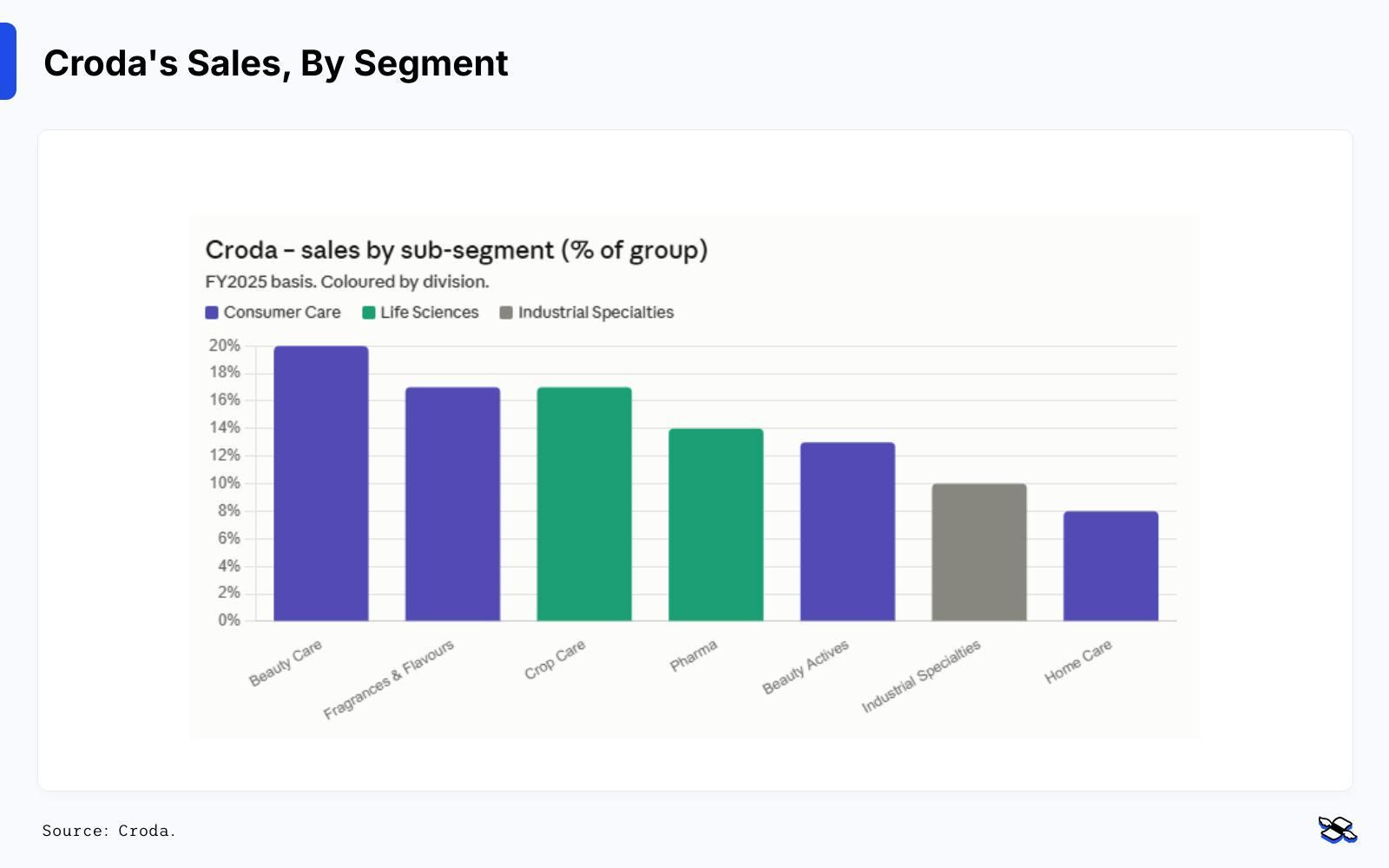
Most of Croda’s sales are in consumer care and pharma segments. Source: Croda.
That may sound like commodity chemistry – cheap, easily-sourced chemicals that a lot of suppliers can make. It isn’t. Croda’s ingredients usually make up only a tiny share of the finished product, but they do the heavy lifting: making them feel right, stay stable, absorb properly, and work better. These ingredients are difficult to swap out – and therefore more valuable.
The company reports across three divisions. The biggest is Consumer Care, which makes up roughly 60% of sales. This is the part of Croda tied to beauty, personal care, home care, and fragrances.
Beauty Actives (13% of group sales) sells premium skincare ingredients, including peptides, retinoid alternatives, and plant-based actives used in anti-ageing and prestige beauty products.
Beauty Care (20% of group sales) provides the functional ingredients in personal care products – shampoos, body wash – like emulsifiers, surfactants, and conditioning agents.
Home Care (8% of group sales) sells similar ingredients into laundry, dishwashing, and cleaning products.
And Fragrances & Flavors (17% of group sales), built around the Iberchem and Parfex acquisitions, supplies scents and flavors largely to mid-market and regional consumer brands.
Sales here are driven by beauty innovation, premium skincare demand, fragrance growth, consumer-product launches, and the shift toward more sustainable ingredients. Its customers include big beauty and personal care groups like L’Oréal, Unilever, Procter & Gamble, Estée Lauder, Shiseido, Beiersdorf, LVMH, Coty, Reckitt, and Henkel. Closest listed competitors include Givaudan, Symrise, IFF, DSM-Firmenich, Ashland, Evonik, and BASF.
Then there’s Life Sciences, at roughly 30% of sales. This division has two main parts: Pharma and Crop Care.
Pharma (14% of group sales) sells drug-delivery ingredients, vaccine adjuvants, and high-purity lipid systems used in areas like mRNA vaccines, gene therapy, and gene editing. Its Avanti Polar Lipids business is especially important because it gives Croda a position in the small group of suppliers capable of making medical-grade lipids used in lipid nanoparticle-based medicines.
Crop Care (17% of group sales), meanwhile, sells adjuvants, dispersants, emulsifiers, biostimulants, and seed coatings that help agricultural chemicals work more effectively. Sales here are driven by pharma development pipelines, commercial drug launches, vaccine demand, crop protection demand, and seed-treatment volumes. Its customers include global biopharma companies, biotech firms, contract manufacturers, and agrochemical groups like Bayer Crop Science, Syngenta, BASF, Corteva, and FMC. Closest listed competitors include Merck KGaA, Evonik, CordenPharma, BASF, Clariant, Solvay, and Novonesis.
The smallest division is Industrial Specialties, at roughly 10% of sales. This is the remaining piece of Croda’s old industrial portfolio after it sold most of that business to Cargill in 2022. It supplies ingredients for coatings, lubricants, polymer additives, energy technologies, water treatment, textiles, and industrial cleaning. It’s more cyclical and lower-margin than the other two divisions, but it still provides useful cash flow and manufacturing scale. Closest listed competitors include BASF, Clariant, Solvay, Arkema, and Elementis.
